•7 min read
Your Brain Won't Let You Quit Your Phone. But It Left a Back Door Open.
- digital addiction
- curiosity
- neuroscience
- behavior change
Your phone exploits one kind of curiosity, but another kind can loosen the craving loop without relying on willpower.
Ever watched a baby examine its own hand? They turn it slowly, staring. No agenda. They're not trying to figure anything out. They're just absorbed in the weirdness of having fingers.
That kind of attention still exists in your brain. You just haven't used it in a while because the same mechanism that locks you into checking your phone at midnight, long after you stopped enjoying it, also buries it.
The Itch and the Opening
Not all curiosity works the same way. The word covers two completely different states, and confusing them is a big part of why screens have such a grip on us.
The first kind is deprivation curiosity. Your phone buzzes in your pocket during dinner. Suddenly it's very hard to pay attention to the person across from you, because not knowing who texted creates a low-grade itch that keeps nagging. This is the need-to-know. It's focused, contracted, restless. The same thing that makes you click a headline that says "You Won't Believe What Happened Next." You don't even enjoy clicking. You just can't not click. The itch demands to be scratched.
The second kind is open curiosity. It has nothing to do with filling a gap. It's the pleasure of noticing something you weren't looking for. Watching a bird do something weird outside the window and realizing five minutes passed without any effort. No itch. No destination. Just the process being enough on its own.
Every notification, every red badge, every infinite scroll is engineered to trigger the first kind. The whole business model behind your phone runs on that contracted, itchy, need-to-close-the-loop feeling. That's not a design flaw. That's the design.
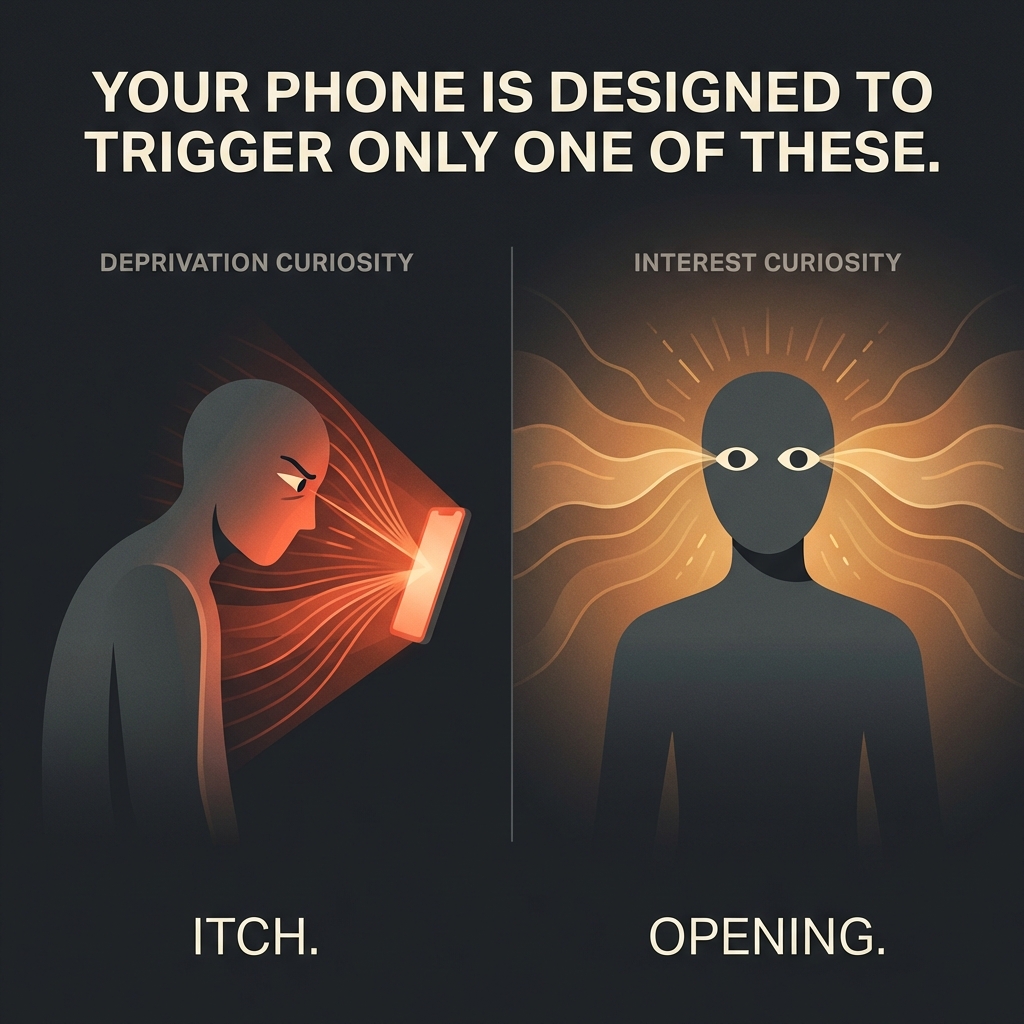
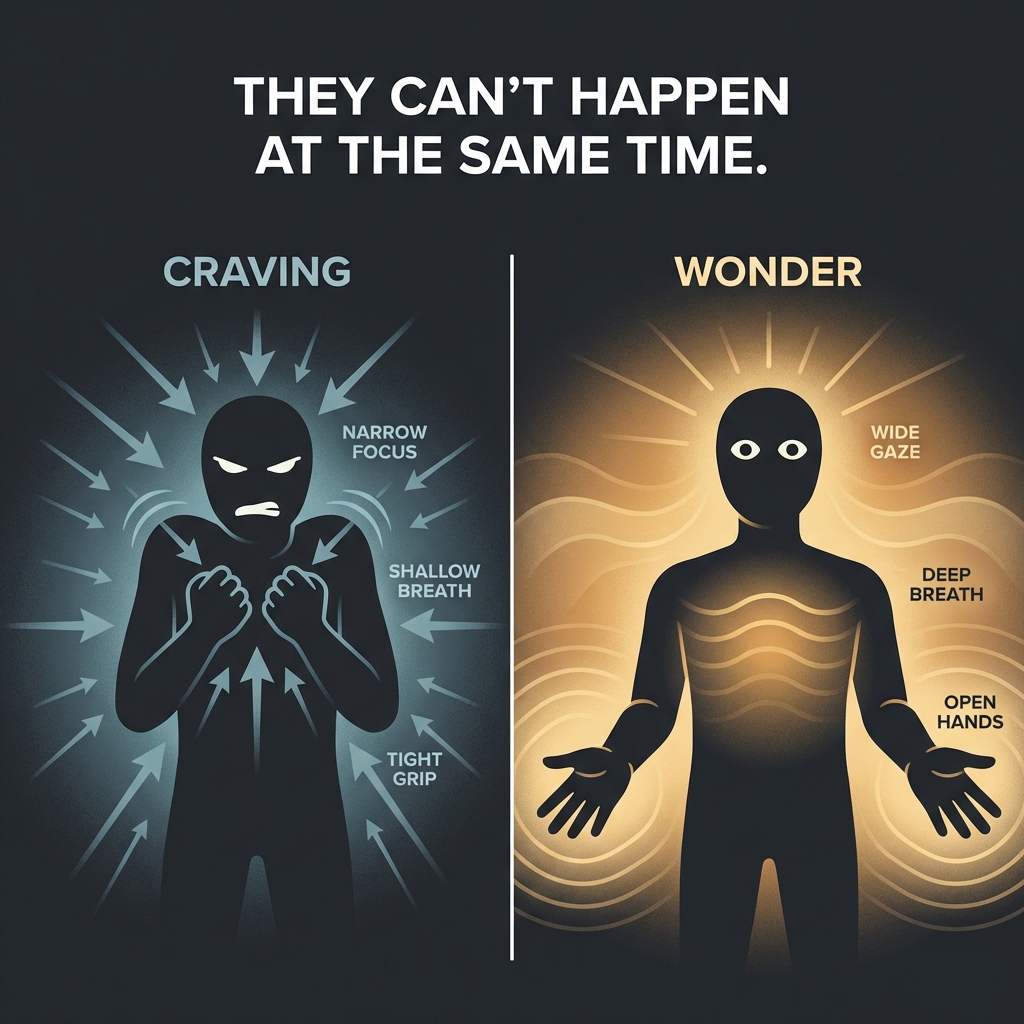
Open curiosity feels completely different in your body. Deprivation curiosity narrows your attention, tightens you up, pulls you forward. Open curiosity does the opposite. Your focus goes wide instead of narrow. Your breathing slows down. You're not hunting for anything. You're just noticing what's already there.
And here's the key: open curiosity is satisfying on its own. Your brain doesn't need a payoff. Which means it can actually compete with the empty reward your phone keeps promising, not by fighting the craving, but by offering something the craving can't match.
What This Does to Your Brain
A craving is a confident prediction: "checking the phone will feel good." That prediction may not even be true anymore, but it's so loud it drowns out the actual experience. And when your brain is sure of that prediction, the doors close. New data can't get in. The model can't update. You're stuck running old software.
Open curiosity reverses this. It shifts the balance so that incoming sensory data gets turned up and the predictions get turned down. The brain stops guessing so loudly and starts listening again.
Meditation research shows the same pattern. The parts of the brain that absorb new sensory information, which shut down when we're depressed or locked into certainty, come back online during open, mindful attention.
This is not a metaphor. Deprivation curiosity feels not-knowing as an unbearable itch. An openly curious mind feels it as an invitation. That uncertain feeling is a sign the old prediction is losing its grip. The sensory channels are reopening. Information that was locked out is starting to flow back in.
The wobble is the system coming back online.
Cognitive scientist John Vervaeke calls this the difference between problem solving and wonder. Curiosity in the deprivation sense is focused: what's the answer? Wonder is what happens before any question forms. It's the "Oh" that comes when something catches you off guard. It doesn't try to land anywhere. And because it doesn't need a destination, it can hold the door open long enough for your brain to actually update.
Opening the Door
The craving loop breaks not by resisting it, but by changing how you pay attention.
You feel the pull toward your phone. Instead of grabbing it or white-knuckling against it, you turn toward the craving itself. Not to analyze it. Not to make it go away. Just to look at it.
You notice the craving isn't a single thing. It's a bundle of sensations. Heat in the chest. Tightness in the hands. A restless vibration somewhere behind the sternum. When you observe it this way, the craving loses its grip. It stops being "I NEED TO CHECK MY PHONE" and becomes information. Warmth, tension, a buzzing feeling.
Psychiatrist Judson Brewer, who has spent twenty years studying this mechanism, puts it simply: instead of "oh no, here's this urge and I have to resist it," you ask "what does this craving feel like right now?" That question brings you back to what you're actually feeling, which means the doors start reopening. And it taps into the satisfaction of curiosity itself, which is more rewarding than the hollow thing the phone was offering.
Smoking and doomscrolling look nothing alike from the outside. But to your brain, the underlying loop is identical: trigger, prediction, contracted attention, automatic behavior.
Brewer's research found that teaching people to be curious about their cravings was twice as effective as the best standard therapies for quitting smoking, and cut craving-related eating by forty percent within two months. Change the quality of attention and the whole chain shifts, regardless of what the behavior is.
There is a catch, though. When you turn toward a craving with curiosity instead of grabbing the phone, you feel something ambiguous. A wobble. Uncertainty. It's natural to read this as "it's not working."
It's the opposite. That discomfort is the feeling of a locked door finally swinging open.
The Move
Next time you feel the pull, your hand moving before the thought even forms, try this.
Don't grab the phone. But don't clench your jaw and force yourself not to, either. Instead, get curious about what's happening inside you. A piece of glass and metal sitting on the table is making your chest vibrate and your hands twitch. That's objectively strange. Look at the craving the way that baby looks at its own hand. Not diagnosing, not fighting. Just noticing that it's happening at all.
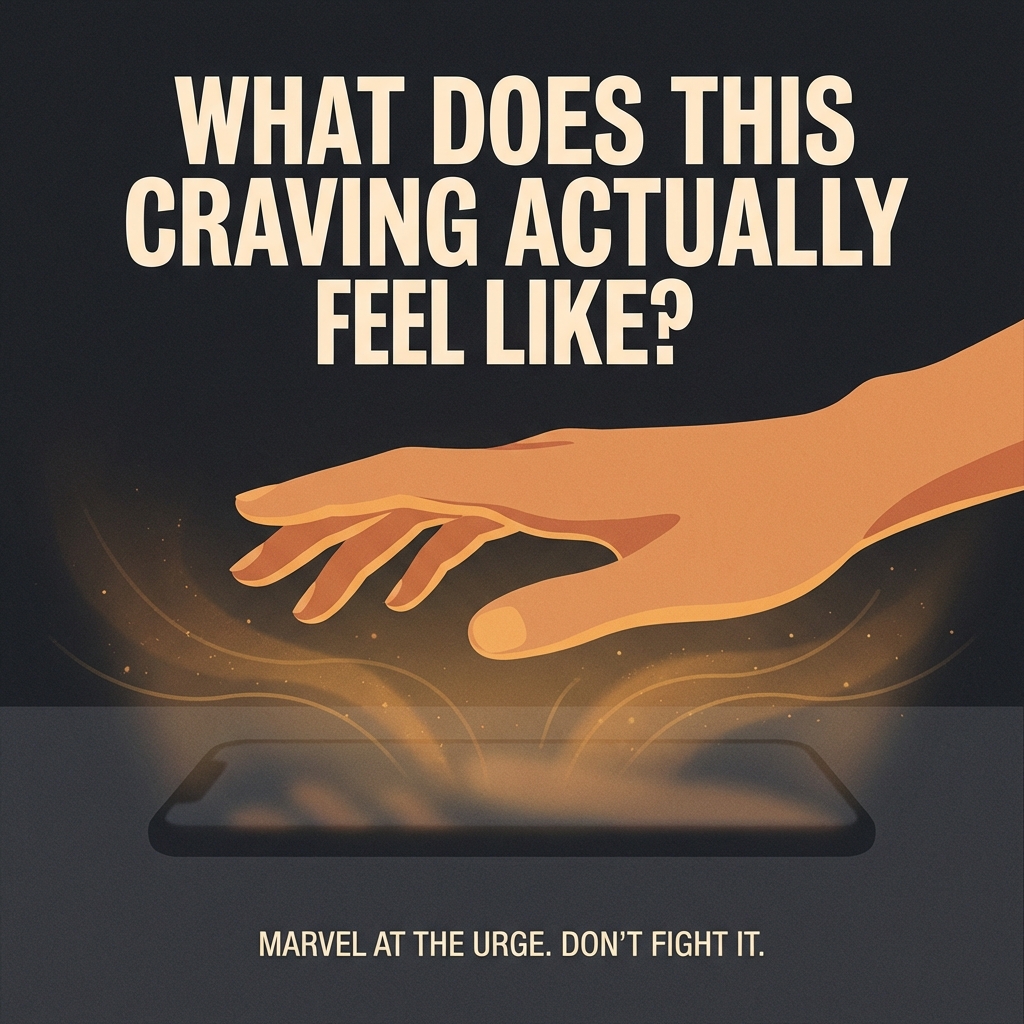
Widen your eyes. Not metaphorically. Physically let your gaze go soft and broad. Take a breath that drops into your belly rather than catching in your chest. And then just stay with what you find. What does the craving actually feel like as a physical sensation? Where does it live? Is it still or moving? Hot or cool? You're not filling out a worksheet. You're examining something genuinely weird: your own body responding to an object that isn't even touching you.
The craving may pass. It may not. That's not the point. The point is that for those seconds, the doors were open. You were receiving actual data about your experience instead of running on autopilot.
And every time you do this, the prediction updates a little. The brain registers that the craving felt like tightness and heat, and that it passed on its own. The phone wasn't needed.
Brewer's research suggests this doesn't take years. Within ten to fifteen repetitions of genuinely paying attention to a craving, the phone starts losing its pull. Not because you decided it should. Because your brain finally received the evidence it had been blocking.
This works because you're not fighting fire with fire. You're replacing contraction with expansion.
You're meeting an itch with wonder. And wonder, unlike willpower, doesn't run out.
What's on the Other Side
When the grip loosens, the time you get back isn't empty. First you notice the craving. Then you start noticing other things: something about the light in the room, the way a conversation changes when someone laughs, how a problem you'd been stuck on suddenly rearranges. The world gets more interesting when you stop watching it through a screen.
You already know how to do this. You did it before the phone. You did it as a baby, staring at your own hand for no reason.
The question is whether you'll try it on the craving. Just once.